

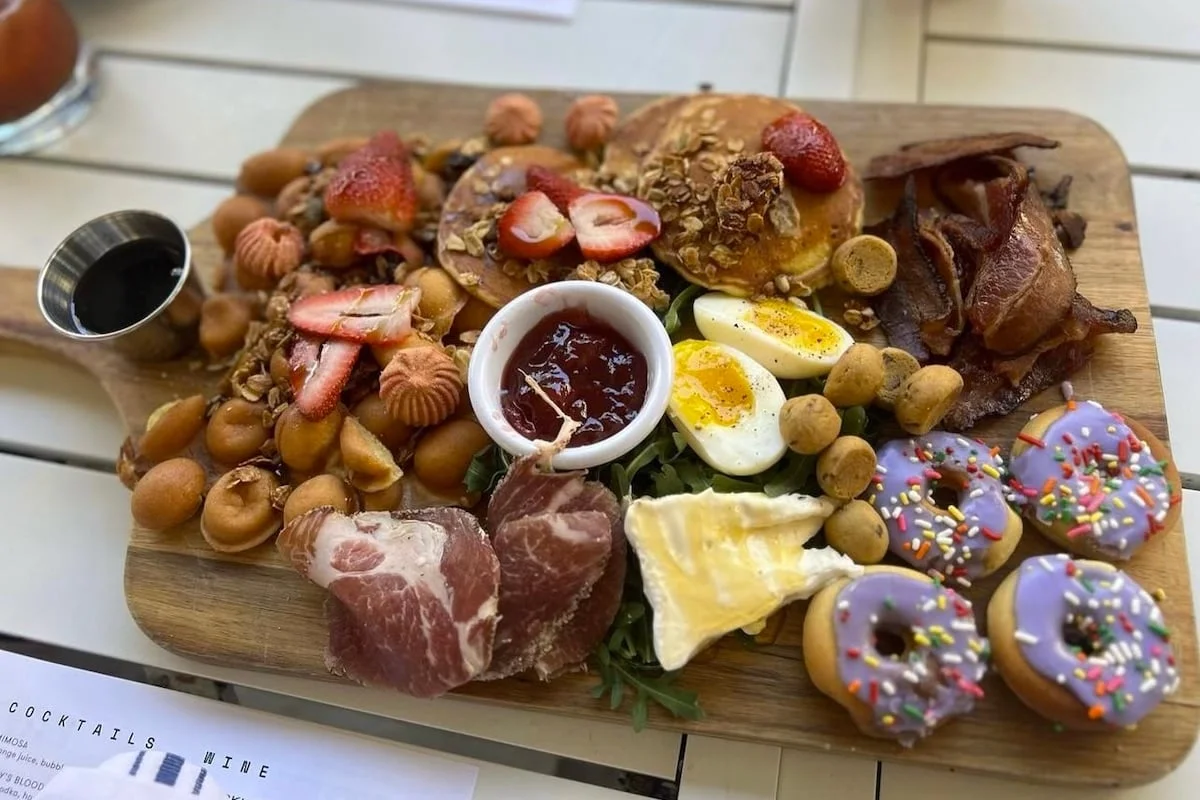
The Breakfast Board at Birdy’s Behind the Bower applies the charcuterie board format to the morning daypart, incorporating sweet, savory and creamy components.
Credit: Birdy’s Behind the Bower
The Morning Mélange
Why mixed boards belong on the breakfast menu
Despite this enthusiasm, Elder-McClure worried the simit wouldn’t sell well individually, so she decided to build a board around the pull-apart bread.
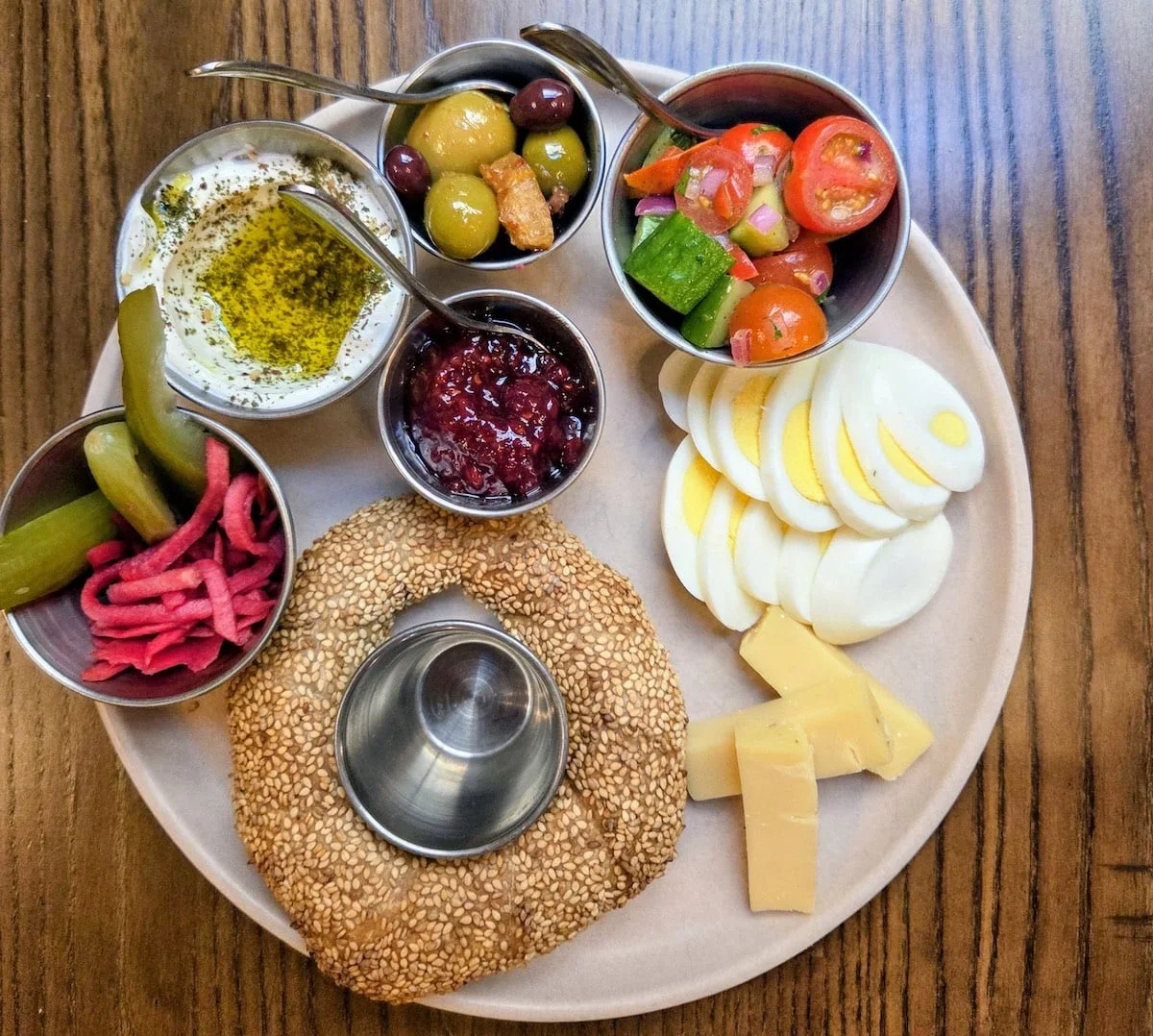
“People don’t know what simit is, but they can understand Turkish breakfast,” she says. In crafting Cafe Yaya’s Turkish-ish Breakfast platter for the weekend brunch menu, the chef also took inspiration from the way she herself likes to eat. “It’s like girl dinner but girl breakfast, so you have a bunch of different things—olives, cheese, seasonal fruit jam, pickles, labneh, hard boiled eggs—so you can make your own bite every time.”
The plate also features a Levant-inspired shepherd’s salad made with cucumber, tomato, bell pepper, red onion and lemon-olive oil vinaigrette, adding more acid to balance out the richness of creamy housemade labneh and aged Comté. Cafe Yaya chef/co-owner Zach Engel suggested putting the French cheese in the mix, even though farmer’s cheese, feta and Palestinian Nabulsi are the typical options on a traditional Turkish breakfast platter (called kahvaltı).
Elder-McClure calls Cafe Yaya’s board a “slightly altered” version of Turkish breakfast, but the name still resonated with a.m. customers. “When we first put it on the menu, we called it a ‘snack-y platter,’ but it didn’t sell very well,” she says. “When we changed it to Turkish-ish Breakfast, it started selling a lot more because I think people understood what we were trying to do.”
At Birdy’s Behind the Bower in New Orleans, chef Marcus Woodham’s Brunch Board was inspired by the popular charcuterie plates at sister wine bar/restaurant, The Bower. “We thought about all the cool things we like about evening charcuterie boards that could be enjoyed at breakfast,” he recalls. “It all kind of eats the same when you think about it: meat, cheese, dairy, some type of bread, i.e., a waffle or pancake.”
So, Birdy’s added a sharable brunch board to the opening menu, which comprises an indulgent mix of sweet (think: mini waffles, mini donuts, mini pancakes, cookie bites), savory (housemade prosciutto or spicy coppa) and creamy items, like a honey-drizzled triple cream délice de Bourgogne. Woodham describes the last as “nice and smooth and not super-pungent or too offensive for early in the a.m.” It’s not only a way to get guests to hang out and drink a little longer (made easier by the bottomless brunch mimosas), but it also reminds Woodham of how he and other families ate growing up.
“Every culture and cuisine has some type of Sunday family spread,” he says. “You go to a Mexican household and there are meats, sauces, cremas and vegetables.” Raised in southern Louisiana with a Lebanese stepfather, Woodman says Thanksgiving was “a huge, gaudy spread” with all the American staples plus Middle Eastern dishes: kibbeh, lamb, stuffed grape leaves. “I grew up with that style of eating, so having the wine bar and charcuterie just made sense,” he explains.
 Credit: Cafe Yaya
 Inspired by Turkish breakfast and girl dinner, the Turkish-ish Breakfast at Cafe Yaya invites guests to customize each bite, try new components and share the experience.
The challenge of breakfast boards isn’t the pool of potential components—on the contrary, the options are as vast as the world’s cuisines—but rather the nature of the daypart itself. “Breakfast in general is tough in that people know exactly what they want and they don’t really stray too far. They aren’t always very adventurous.” Blade & Tine Culinary Consulting chef/owner Jason Hernandez served brunch boxes and boards when he and his wife Heather owned Graze Street AMI in Holmes Beach, Fla.
“That morning segment was kind of missing because having a ‘nduja and a creamy cheese at 10 a.m. was not filling that gap, so we created brunch and toast boards,” he says. The couple mixed the familiar with the fun, including waffles, whipped feta dips, bodega-style breakfast sliders, egg bites, ham and Gruyère hand pies, as well as spreadable Brie and honey. He sees potential in breakfast boards that could work across cuisines, from Brazilian to Japanese. “Every culture and cuisine has its level of pastry—something sweet, something savory—and nothing was off the table for us. We’d get requests for breakfast burritos, so we would make smaller versions that were more of a bite,” he says.
But building a breakfast platter of any kind is about balance. “Over time, we learned about the quantity of food. You can get carried away with how much bread and carbs you are putting on, the portion of spreadable cheese versus hard cheese, proteins, etc.,” Hernandez adds. Other things to consider include color, temperature, texture and the right mix of tools, from mini tongs and picks to five-finger style. “But I think what’s important for these breakfast boards is having a wide combination of flavors and both sweet and savory, or you’re just making a single dish.”
As for Elder-McClure, she thinks people are moving away from heavy, large-format dishes and opting more for a “grazing situation” at any daypart. “I think people are getting more into that type of eating,” she says. “They’re trying to change their diets and eat healthier—and it’s better for sharing.”
About the Author
 Liz Grossman has been a Chicago-based writer, editor and storyteller for 25 years. She’s the former editor-in-chief of Plate, a national, award-winning trade publication for the professional chef industry. As co-founder of the nonprofit storytelling series, Between Bites, Liz is passionate about live lit and giving back to the Chicago food community. She has served as a James Beard judge for the Chef and Restaurant Awards and has also served as a moderator for the FAB, Mise and the CIA Worlds of Flavor and Menus of Change conferences. Her writing has appeared in Newsweek, Chicago, Robb Report, Veranda, Food Service Director and more. Follow her at @elizabites_ChiRead More Stories by Liz Grossman
Rip, Tear and Pull-Apart Breads Menuing four fun, interactive styles
Flavor Trends, Strategies and Solutions for Menu Development[google_sidebar_ad adslug="2026-04-Surround-Kens-320x50"...
Tart Cherries Make Flavor Magic Reimagine ways to put their power of sour to work in modern menu development
Flavor Trends, Strategies and Solutions for Menu Development[google_sidebar_ad...
Spread a Little Indulgence Clean-label nut butters deliver dairy-free creaminess with a naturally premium read
Flavor Trends, Strategies and Solutions for Menu Development[google_sidebar_ad adslug="2026-05-Surround-Puratos-320x50"...
