









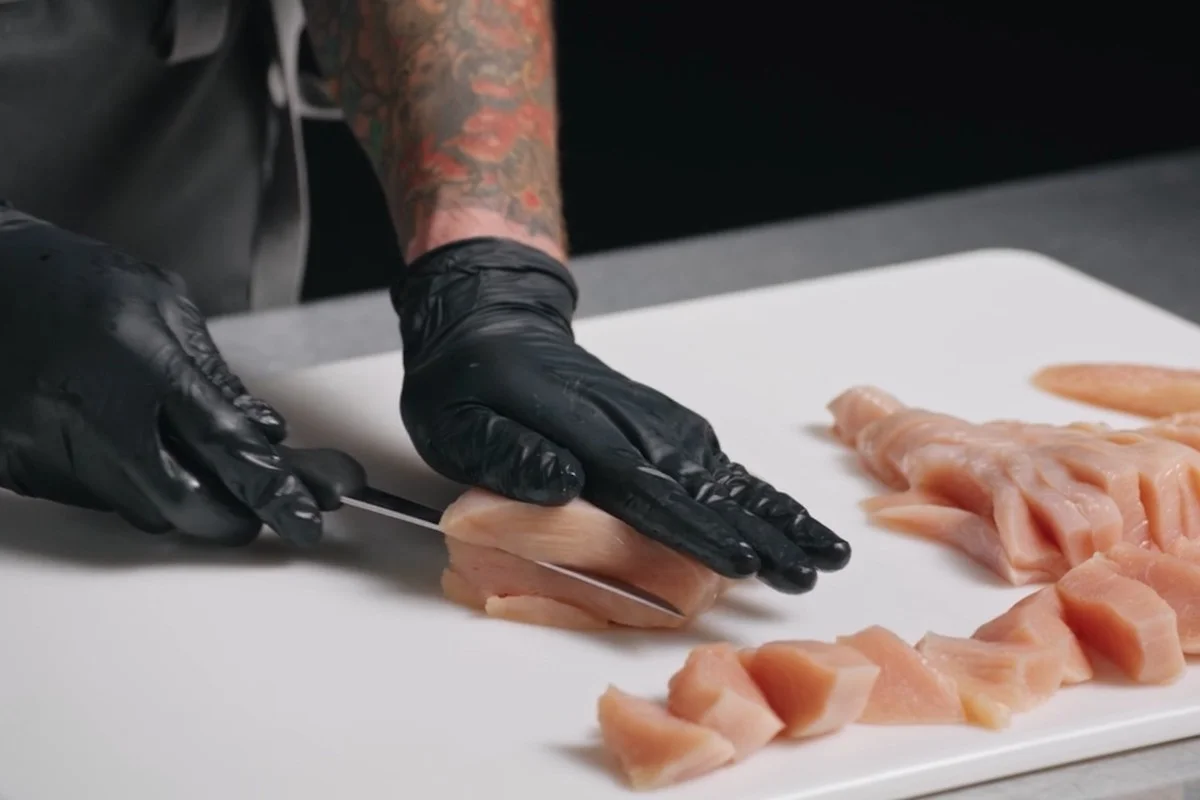
Use of high-quality chicken primals offers numerous advantages over breaking down the bird in your kitchen.
Credit: Mountaire Farms
SPONSORED EDITORIAL
Reclaim the Cutting Edge
Trading back-of-house butchery for recipe-ready chicken primals
Labor sits squarely at the top of the list of reasons to believe. “Labor, labor, labor. It feels like every conversation I ever had with my general manager was about getting labor down,” says Chef Daniel Ernce, corporate chef, Austin Amplifies. “Good help is hard to find. And if you can find it, good help isn’t cheap.” This is especially true when it comes to executing high-quality, back-of-house butchery at a speed and yield that continually promotes profit.
“Butchery is one of those culinary skills that takes an amazing amount of time and dedication to perfect and, unfortunately, is becoming more and more rare,” reports Chef Ian Clark, founder/principal, Bent Spoon Consulting. “Training staff to properly butcher a variety of animals while keeping yields and waste in check—and keeping staff injuries to zero—poses a steep learning curve.” Simply put, few foodservice operations have the capacity to absorb the costs and risks associated with back-of-house butchery training and execution.
Ernce concurs. “Every time you set a fresh bird down in front of a trainee, you’re putting your hard-earned dollars on the line and accepting that less-experienced cooks will damage or miscut product multiple times in the process of becoming proficient,” he notes. “You’re caught between losing money in time and product to train a cook to butcher versus paying through the nose for an experienced veteran.”
There’s another option: Turn to the pre-trimmed, recipe-ready chicken products in the Mountaire® Black Label line. “It is an absolute game-changer for kitchens across the spectrum,” says Clark. “It gives chefs the quality and consistency they crave, while lowering back-of-house labor costs and raising peace of mind that the crew is safe and can focus on what’s most important.” Streamlining the butchery process by starting with trimmed whole muscles allows more time to finish other prep—and maybe even get ahead of to-do list demands.
When working with poultry in great quantities, small problems can lead to big ones. The consistent sizing of Mountaire® Black Label primals increases yield—which is the only thing that matters. It makes no sense to save pennies on lesser products only to lose dollars trying to make an odd shape fit.
—Pat LaFrieda, CEO, Pat LaFrieda Meat Purveyors
The Mountaire® Black Label product line features single- and double-lobe boneless, skinless chicken breasts; first and second joint chicken wings; boneless back-half products, including thighs and the whole, boneless Mountaire® Chicken Chop™; and bone-in drumsticks. Following are three more challenges common to kitchen butchery and how Mountaire® Black Label chicken primals can help chefs resolve their concerns.

Primal chicken cuts produce consistent quality and yields unmatched by back-of-house butchery.
CHALLENGE: WASTE & STORAGE
While reducing the food waste produced during kitchen prep is a laudable goal with both bottom line and environmental implications, the hard truth is that it’s difficult to use all the trim from butchery—especially in high-volume, fast-paced operations. Transforming such “free” byproduct may actually cost a great deal in time, resources and space.
“There is always a case to be made that trim or scrap from butchery can be used, and on paper it always works out,” says Clark, citing a variety of menu items like chicken potstickers, meatballs, charcuterie, sausages, stocks and broth and chicharrons. But they are expensive to produce and complex to menu in appropriate volumes.
Kitchens also must account for the other major cuts, not just the trim. Butchering a whole bird will yield wings, tenderloins, drums, thighs and breasts—and the chef needs to find homes for all of these on the menu—and there may not be an equivalent demand for all the different pieces, notes Ernce, running the numbers: “Butchering 10 birds will yield 20 breast entrées and 20 wings, which may be only two or three orders. Now, an operator is trying to create five different dishes to use the whole bird, which can pigeon-hole the operation and make guests feel like they have only one choice: chicken.”
“Maybe it’s your spicy Korean fried chicken thigh sandwich that’s a top-seller on the menu, but the rest of the products from the whole bird start piling up, whether further processed, costing added labor, or in raw form, producing waste,” continues Clark. “Mountaire® Black Label allows you to bring in only what you need for the top sellers on the menu.”
CHALLENGE: HUMAN ERROR
The more angles and cuts a cook must make to achieve a finished product, the greater the chance for errors, including personal injury. By starting with trimmed primal cuts, fabricating cutlets or nuggets is a straightforward process with simple, easy cuts that are less likely to risk injury than deboning whole birds.
Human error also can compromise operational efficiency. “We used to race to see who could butcher a case of chickens the fastest,” says Ernce, acknowledging kitchen realities where common sense sometimes gives way to competitive spirit. “I had one guy who constantly bragged about how fast he was—and he was. But when it came time to use his butchered product for service, we were constantly finding bones and cartilage that needed more time and effort to remove, grinding service to a halt.”
CHALLENGE: INCONSISTENCY
Inconsistent prep can cause unreliable results, affecting guest satisfaction and compromising the potential of repeat visits. Back-of-house butchery can risk inconsistencies, particularly in overall yield, portion sizes and quality. But Mountaire® Black Label products are ready for the line every time.
These products are 100 percent all-natural and minimally processed, with the size variation that occurs in a given bird weight range. Through careful selection, consistent trimming and bone scanning, Mountaire offers chefs greater control in recipe production than in-house butchery typically provides.
“Consistency is absolutely everything in a foodservice operation! Consistency, day in and day out, is what separates successful kitchens from kitchens that fail,” insists Clark. “Knowing that Mountaire Black Label chicken products will help ensure you can break down those primals into cuts with a consistent size, weight and cleanliness is such a huge win for operators.”
Ernce agrees: “With Mountaire’s products, you get everything you need, and nothing you don’t.” In fact, starting with a trimmed product, free of bones and ready to portion, leads to significantly more usable protein meat per case, saving storage space and time.
Ready to get cooking with Mountaire® Black Label chicken? Click here to download a complete product guide.

Rip, Tear and Pull-Apart Breads Menuing four fun, interactive styles
Flavor Trends, Strategies and Solutions for Menu Development[google_sidebar_ad adslug="2026-04-Surround-Kens-320x50"...

Tart Cherries Make Flavor Magic Reimagine ways to put their power of sour to work in modern menu development
Flavor Trends, Strategies and Solutions for Menu Development[google_sidebar_ad...
Spread a Little Indulgence Clean-label nut butters deliver dairy-free creaminess with a naturally premium read
Flavor Trends, Strategies and Solutions for Menu Development[google_sidebar_ad adslug="2026-05-Surround-Puratos-320x50"...
