

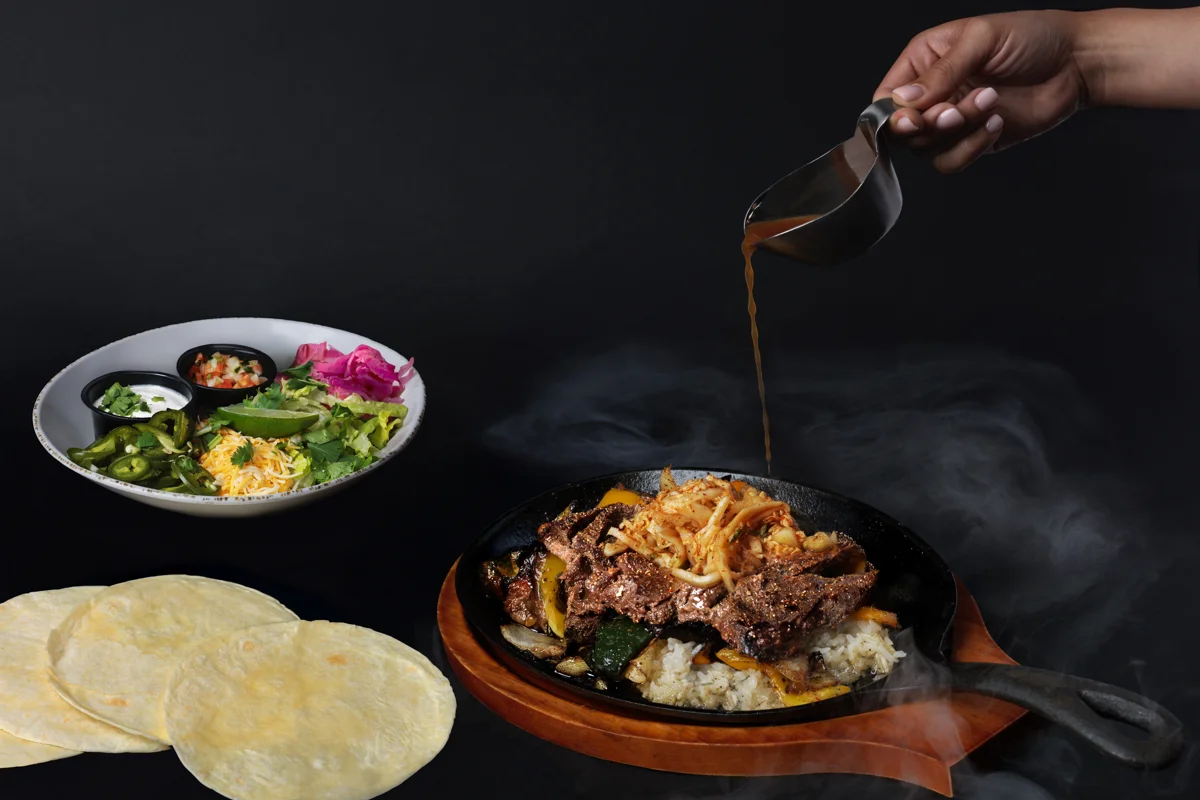
At Miami-based Lime Fresh Mexican Grill, smoky kimchi aïoli adds dimension to the Bim Bim Fajita, underscoring how readily kimchi fits into global mash-up culture.
Credit: LIME Fresh Mexican Grill
Kimchi’s Next Wave
A Korean staple evolves into a flavor platform
“Kimchi is gaining what we call ‘slow status,’ meaning steady growth,” says Claire Conaghan, trendologist and associate director of publications at Datassential. She notes a meaningful rise in an affinity for kimchi over the past two years, along with an almost 2 percent penetration on non-global menus, an impressive benchmark for an ingredient this complex. She points to its versatility as a key driver: “It brings texture and tang—a great building block since it’s so flexible across menu parts.”
That flexibility is at the heart of kimchi’s next wave. Chefs and operators are expanding beyond traditional cabbage ferments and exploring kimchi as a broader flavor system, one that can be powdered, puréed, emulsified, infused into butter or cream, or reimagined as a seasoning or glaze. These new expressions allow kimchi to show up in more approachable forms, ushering the concentrated flavor into unexpected applications and making it easier to use kimchi as a high-impact ingredient. From burgers and loaded fries to pastries and cocktails, kimchi is becoming a modern upgrade, bringing acidity, heat and umami to categories that already resonate with American diners.
A major catalyst in this evolution is the cultural halo surrounding Korean food today. K-pop, K-dramas, Korean barbecue, Korean fried chicken and Korean street foods have built a foundation of warm familiarity, especially among younger consumers. Also, broader interest in fermentation and gut health has created new openness to tangy, funky flavors. Kimchi sits at the intersection of these forces. Its boldness feels exciting, not intimidating, and its connection to tradition gives it authenticity even in cross-cultural applications. This combination of cultural relevance, flavor complexity and functional appeal has pushed kimchi into territory that once seemed unlikely.
 Credit: MADN Agency / Mistey Nguyen
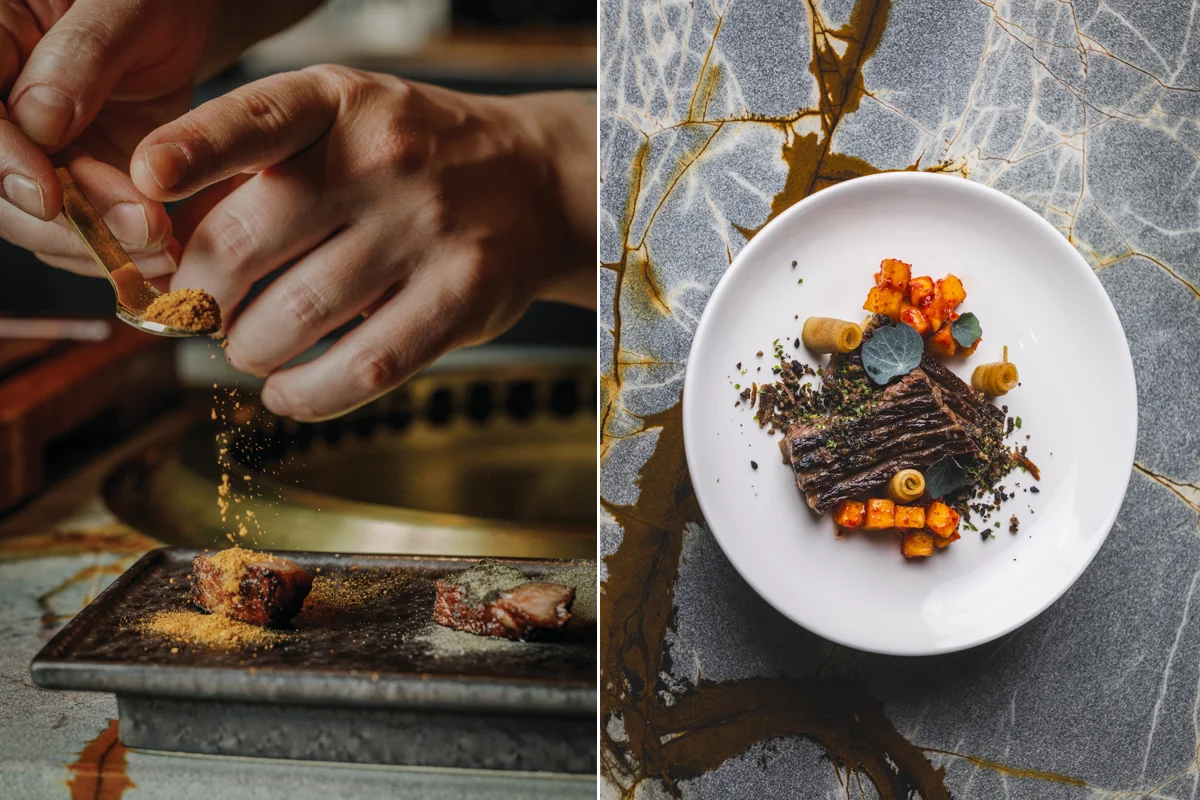
 Kimchi powder stars as a unique housemade topping on the 21-Day Koji-Aged Australian Wagyu at Chicago’s Bonyeon Korean steakhouse.
THE POWER OF FORMAT EVOLUTION
Kimchi’s expanded footprint is tied closely to the rise of new, operator-friendly formats. One of the most transformative is the rise of kimchi in powdered, dehydrated and sprinkle formats. At Bonyeon, an authentic Korean steakhouse in Chicago, housemade kimchi powder stars as a topping on the 21-Day Koji-Aged Australian Wagyu. The powder captures kimchi’s core elements, (spice, tang and umami) without moisture, providing a concentrated form of fermented flavor in a new textural expression. “Sometimes kimchi has a very strong flavor—very spicy, very aromatic,” says Kate Park, co-founder. “The powder lets anyone try the flavor without that strong aroma.”
Bonyeon’s approach to its signature kimchi powder starts with traditional kimchi, which is then dehydrated, allowing the natural sugars, acids and aromatics to condense. It’s then milled into a powder. “Kimchi powder is very modern; it’s not traditional in Korea,” says Park. “The idea came from curiosity. How can a chef capture the essence of fermented kimchi in a more versatile form?” At Bonyeon, kimchi powder becomes both culinary innovation and cultural storytelling, a format that preserves kimchi’s soul while opening new doors for texture and technique.
Across the country, kimchi powder and seasoning sprinkles are showing similar promise. Atomix, an upscale restaurant in New York, menus langoustine served with a kimchi glaze, tomatoes, pickles, rice sauce and kimchi powder. Motomaki, an Asian-Hawaiian fast casual with locations in Colorado, uses kimchi sprinkles to season cucumbers, adding crunch and heat to its lineup of Big Rolls, oversized, burrito-style maki rolls.
Creamy and emulsified kimchi applications are also shaping the next wave in kimchi adoption. Fat integration, blending kimchi into mayonnaise, aïoli and butter, tempers the sharper fermented notes while amplifying savoriness. “Kimchi in sauce applications may be the training wheels needed to remove the stigma around what kimchi is or is not—for both young and aging tastebuds,” says Rebecca Peizer, culinary consultant. “Dipping sauces like kimchi-barbecue sauce, kimchi aïoli and kimchi ketchup are easy ways to incorporate kimchi.”
This approach is helping introduce kimchi to diners who may be unfamiliar with traditional versions. At Miami-based fast casual Lime Fresh Mexican Grill, smoky kimchi aïoli adds dimension to a Bim Bim Fajita, underscoring how readily kimchi adapts to Mexican-inspired formats. And at Mashita, a Korean-inspired restaurant in Harrisonburg, Va., Caramelized Kimchi Fries are blanketed with a kimchi cheese sauce, studded with quick-pickle kimchi and scallion, then drizzled with a spicy gochujang sauce. Dishes like these prove the ingredient’s strength in beloved menu items.
Perhaps the most emblematic example of kimchi’s format evolution is kimchi butter. At Shootz, a Hawaiian- and Asian-inspired fast casual based in Stanton, Calif., co-founder Michael Dancel created kimchi butter at a family gathering, whipping butter with gochugaru and proprietary spices, along with a touch of brown butter. Its appeal was immediate. The version now served at Shootz has been refined, evolving into a craveable flavored butter that has helped define the brand’s identity. It’s featured extensively on the menu, from the Hot Kimchi Butter Katsu Chicken Sandwich, served on a toasted Hawaiian bun, to the Kimchi Butter Shrimp. “Our kimchi butter turned into something viral. People kept talking about it,” says Dancel. “It’s our signature ingredient and tastes amazing with everything on our menu.”
Chibi, a fast-casual ramen restaurant in Orlando, Fla., has similarly built momentum around a kimchi-butter sauce. It anchors the concept’s top-selling Boneless Wing Bites Rice Bowl with crispy chicken bites tossed in a signature kimchi-butter sauce, seasoned soft-boiled egg, house mayo, yuzu-pickled daikon radish and scallions.
 Credit: Tucci / Art Wynwood
 The Kimchi Lasagna at Tucci in New York is layered with kimchi, bulgogi, perilla leaf and mozzarella (left). Tomatillo kimchi in the Barbacoa Bao Buns at Miami’s Wyn Wyn (right) highlights the opportunity for alternate ingredients in kimchi.
CROSS-CULTURAL MOMENTUM
Kimchi’s growing presence across categories aligns with the broader movement toward global mash-ups and third-culture cooking—styles that bridge cultures through dishes that feel personal and are universally appealing. At Smoking Tiger, a Korean-inspired café based in Cerritos, Calif., kimchi shows up in café classics like the Kimchi Musubi Croissant—tucked in alongside Spam and cheese—and the Kimchi Tuna Melt, enhancing a traditional build with the flavor and texture. Japanese restaurant Uchi, based in Austin, Texas, serves Wagyu Ringo, a coulotte-cut steak, with smoked apple kimchi, and even features kimchi in a cocktail: The Kimuchi stars Haku vodka, kimchi and blood orange. At the iconic Gramercy Tavern in New York, kimchi seasoning-coated sesame seeds elevate a Caraflex Cabbage Cake, served with garlic–peanut chile crunch and housemade Kewpie-style mayo. These dishes highlight kimchi’s ability to enhance a wide spectrum of flavor systems while maintaining its singular identity.
Its reach also extends into comfort-forward formats like pasta. Tucci, a modern Italian restaurant in New York, offers a Kimchi Lasagna layered with kimchi, bulgogi, perilla leaf and mozzarella. Inventive Italian eatery Void in Chicago builds agnolotti around Korean sweet potato, ricotta, mozzarella and kimchi in its Agnolotti del Lungo. It’s well evident that kimchi is no longer limited to Korean dishes. It’s becoming a universal enhancer, much like pickles and sauerkraut.
THE OPPORTUNITY
For operators, kimchi’s evolution presents a wide runway for innovation. The ingredient’s growing familiarity positions it as a natural upgrade to dishes that already perform: burgers, fried chicken sandwiches, fries, rice bowls and quesadillas. Using kimchi as a topping, swirl-in or accent can add global appeal without wholly reinventing a menu.
Kimchi-infused fats, such as kimchi butter or kimchi aïoli, offer a particularly strong path forward. They deliver bold, dimensional flavor while fitting easily into cherished favorites. Dried kimchi formats—powders, sprinkles and seasonings—provide concentrated impact with minimal labor, making them ideal for high-volume concepts looking to add a distinctive flavor punch.
There is also meaningful opportunity in expanding the types of kimchi used. Beyond cabbage, chefs are experimenting with carrot, pineapple, tomatillo and apple kimchis, each offering unique texture, sweetness and seasonal relevance. These variations give menus room to tell deeper stories about fermentation while keeping the ingredients fresh. And because kimchi aligns with broader consumer interest in fermented foods, it can be positioned as both a flavor-forward and wellness-adjacent component—an advantage in today’s climate of mindful eating.
About the Author
 Katie Ayoub serves as managing editor of Flavor & The Menu and content strategist for the Flavor Experience, an annual conference geared toward chain operators. She is president of Katie Ayoub & Associates, serving up menu trends expertise, content creation and food & beverage consultancy. Based in Chicago, Katie has been working in foodservice publishing for more than 20 years and part of the Flavor team since 2006. katie.ayoub@gmail.comRead More Stories by Katie Ayoub
Culinary Versatility in a Nutshell Crack open the many ways to get more from walnuts
Flavor Trends, Strategies and Solutions for Menu Development[google_sidebar_ad...
Generation Next: Across the World for a Sweeter Beginning The future of food is evolving, one culinary student at a time
Flavor Trends, Strategies and Solutions for Menu DevelopmentCaera Stone (right) profiled her friend...
Modernizing Five Classic Dips Easy upgrades to enhance the dipping experience
Flavor Trends, Strategies and Solutions for Menu Development[google_sidebar_ad adslug="2026-03-Surround-Kens-320x50"...
